After the Lord’s Ascension, the Mother of God remained under the care of the Apostle John the Theologian, and when he was absent, she lived in the house of his parents, near the Mount of Olives. For all the Apostles and all the faithful, she was a consolation and edification. Talking with them, the Mother of God told them of the wondrous events of the Annunciation, the conception without seed, and her birth of Christ without corruption, His childhood and earthly life. Like the Apostles, she instructed and strengthened others in the Christian Faith by her very presence, words, and prayers. The Apostles’ reverence for the Most Holy Virgin was extraordinary. Upon receiving the Holy Spirit on the remarkable day of Pentecost, they remained in Jerusalem for about ten years, serving for the salvation of the Jews and wishing to see and hear her divine words as often as possible. Many of the newly-enlightened in the faith even came from distant lands to Jerusalem in order to see and hear the Most Pure Theotokos.
During the persecutions brought by Herod against the young Christian Church (Acts. 12:1–3), the Most Holy Virgin Mary, together with the Apostle John the Theologian, departed in the year 42 for Ephesus, where the lot fell to the Apostle John to preach the Gospel. She was also in Cyprus at the home of St. Lazarus the Four Days Dead, who was acting Bishop there, and on the Holy Mountain of Athos, concerning which, according to St. Stephen the Hagiorite, the Mother of God said prophetically, “This place shall be the portion given me by my Son and God. I will be the Protectress of this place, and an Intercessor for it before God.”
The reverence of the ancient Christians for the Mother of God was so great that they preserved everything about her life that they could note from her words and deeds, and even left us a description of her appearance.
According to tradition based upon the words of the Holy Hieromartyr Dionysius the Aeropagite (†December 20, 107), St. Ambrose of Milan wrote in his work
On Virginity about the Mother of God, “She was a virgin not only in body but also in mind, who stained the sincerity of its disposition by no guile, who was humble in heart, grave in speech, prudent in mind, sparing of words, studious in reading, resting her hope not on uncertain riches, but on the prayer of the poor, intent on work, modest in discourse; wont to seek not man but God as the judge of her thoughts, to injure no one, to have goodwill towards all, to rise up before her elders, not to envy her equals, to avoid boastfulness, to follow reason, to love virtue. When did she pain her parents even by a look? When did she disagree with her neighbours? When did she despise the lowly? When did she avoid the needy? Being wont only to go to such gatherings of men as mercy would not blush at, nor modesty pass by. There was nothing gloomy in her eyes, nothing forward in her words, nothing unseemly in her acts, there was not a silly movement, nor unrestrained step, nor was her voice petulant, that the very appearance of her outward being might be the image of her soul, the representation of what is approved."
According to a tradition preserved by the historian Nicephorus Callistos (fourteenth century), the Mother of God “was of medium height, or as some say, slightly taller than medium height; her hair was golden-like; her eyes quick, and olive colored; her eyebrows were arched and not too black, her nose elongated, her lips blossom-like, and filled with sweet speech; her face was neither round nor sharp, but slightly elongated; her fingers and toes long… She preserved good decency in her conversation with others, not laughing, never upset, and especially never angry; she was absolutely artless, simple; she never thought of herself in the least, and was far from comfort seeking, distinguishing herself by her total humility. As for the clothing she wore, she was content with their natural color, which her sacred head covering still shows. To say it briefly, she manifested especial grace in her every deed.”
The circumstances surrounding the Dormition of the Mother of God are well known in the Orthodox Church from the time of the Apostles. St. Dionysius the Aeropagite wrote in the first century about her Dormition. In the second century, the story of the Most Holy Virgin’s bodily translation into heaven is found in the works of Meliton, Bishop of Sardica. In the fourth century, St. Epiphanius of Cyprus refers to the tradition of the Dormition of the Mother of God. In the fifth century, St. Juvenal, Patriarch of Jerusalem said to the holy right-believing Greek Queen Pulcheria, “Although there is nothing written in Holy Scripture about the circumstances surrounding her (the Theotokos’s) death, we nevertheless know about them from ancient and most reliable tradition.” This tradition was collected and set forth in detail in the ecclesiastical history of Nicephorus Callistos from the fourth century.
Her days and nights were spent in prayer. Often the Most Holy Theotokos came to the Holy Sepulcher of the Lord, censed it around, and bent her knee in prayer. More than once did the enemies of the Savior attempt to prevent her from visiting this holy place, and asked the high priests to set a guard over the Lord’s Sepulcher. But the Holy Virgin, seen by no one, continued to pray before it. On one of these visitations to Golgotha, the Archangel Gabriel appeared to her and told her that she would soon be moving on from this life to the heavenly life, eternal and blessed. The Angel gave her a palm branch as a token of this promise. The Mother of God returned to Bethlehem with this heavenly tidings, along with three virgins who served her (Sepphora, Evigea, and Zoila). Then she called for the righteous Joseph of Arimathea and the disciples of the Lord, to whom she announced her nearing Dormition. The Most Holy Virgin also prayed that the Lord would send her the Apostle John, and the Holy Spirit took him up from Ephesus, placing him next to where the Mother of God lay. After praying, the Most Holy Virgin burned incense, and St. John heard a voice from Heaven that concluded her prayer with the word, “Amen”. The Mother of God said that this voice indicated that the Apostles and Holy Bodiless Powers would soon arrive. Countless Apostles flew in, says St. John Damascene, like clouds and eagles, in order to serve the Mother of God. Seeing each other, the Apostles rejoiced, but asked each other in their perplexity why the Lord had thus gathered them into one place. St. John the Theologian greeted them with tears of joy, saying that the time has come for the Mother of God to depart to the Lord. Going in to the Mother of God, they saw her seated magnificently on her couch, filled with spiritual joy. The Apostles greeted her, and then told her about their miraculous transport from the places of their ministry. The Most Holy Virgin glorified God that He had heard her prayer and fulfilled the desire of her heart, and began to discuss her coming end. During this discussion, the Apostle Paul appeared with his disciples: Dionysius the Aeropagite, the wondrous Hierotheus, the divine Timothy, and others of the seventy Apostles. The Holy Spirit had gathered them all together, so that they would be vouchsafed the blessing of the Most Holy Virgin Mary, and arrange her burial in all magnificence. She called each one to herself by name, blessed them, and praised their faith and labors in preaching Christ’s Gospels. She wished for each of them eternal blessedness, and prayed with them for the peace and well-being of the whole world.
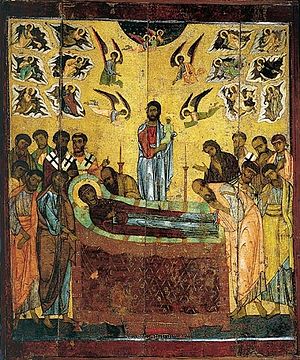
The third hour came, when the Dormition of the Mother of God should occur. Many candles were burning. The holy Apostles with hymns surrounded the magnificently adorned bier on which the Most Holy Virgin Theotokos rested. She prayed in expectation of her departure and the arrival of her beloved Son and Lord. Suddenly, there was a flash of unspeakable Light of Divine glory, before which the light of the burning candles paled. Those who saw it were in fear. The ceiling of the room as if disappeared in rays of incomprehensible Light, and the King of Glory Himself, Christ, descended, surrounded by a multitude of Angels, Archangels, and other Heavenly Powers, with the righteous souls of the forefathers and prophets, who had once foretold the coming of a Most Pure Virgin. Seeing her Son, the Mother of God exclaimed “My soul hath magnified the Lord, and my spirit hath rejoiced in God my Savior, for He hath looked upon the lowliness of His handmaiden”; and, rising from her couch to meet her Lord, she bowed to Him. The Lord called her to the habitations of Eternal Life. Without the least bodily suffering, as if in a pleasant dream, the Most Holy Virgin gave her soul into the hands of her Son and God.
Then began joyous angelic singing. Accompanying the pure soul of the Bride of God with reverent fear as the Queen of Heaven, the Angels cried out, “Rejoice, O blessed one, the Lord is with thee, blessed art thou among women! The Queen and Handmaiden of God has come; receive her ye gates, and fittingly raise the Ever Virgin Mother of the Light; through her has the race of men been saved. We cannot look upon her, nor are we able to render unto her the honor that is meet. The heavenly gates were uplifted to meet the soul of the Most Holy Mother of God, and the Cherubim and Seraphim glorified her with rejoicing. The grace-filled face of the Mother of God shone with the divine glory of virginity, and a fragrance poured from her body.
Wondrous was the life of the Most Pure Virgin, wondrous also was her falling asleep, as the Holy Church chants: “The God of the universe hath shown on thee, O Queen, wonders surpassing the laws of nature. In giving birth, He hast preserved thy virginity, and in the grave, he preserved thy body incorrupt.” Venerating thy most pure body with fear and reverence, the Apostles received from it sanctification and were filled with grace and spiritual joy. To the greater glorification of the Most Holy Theotokos, the omnipotent power of God healed the sick who touched her bier with faith and love. Having wept over their separation from the Mother of God on earth, the Apostles set about burying her most pure body. The holy Apostles Peter, Paul, and James, with others of the twelve Apostles, carried on their shoulders the bier that held the body of the Most Pure Virgin. St. John the Theologian walked at the fore carrying the heavenly, radiant palm branch, and the other saints and a multitude of the faithful walked alongside the bier with candles and lamps, singing sacred hymns. This solemn procession began at Mt. Zion and went through all of Jerusalem to Gethsemane.
At the first movement, a wide and luminous circle of cloud appeared suddenly over the most pure body of the Mother of God like a wreath, and a host of angels joined together with the host of Apostles. The singing of the heavenly powers could be heard glorifying the Mother of God, and this singing was repeated by earthly voices. This circle of heavenly chanters and luminosity moved along in the air, accompanying the procession to the very place of burial. The unbelieving people of Jerusalem, stunned by the extraordinary magnificence of the burial procession and enraged at the honor rendered to the Mother of Jesus, sent word about it to the high priests and scribes. Enflamed with envy and vengefulness for everything that reminded them of Christ, they sent their servants to disperse the procession, and to burn the body of the Mother of God. The angry crowd and soldiers headed wrathfully toward the Christians, but the cloud-like wreath that followed in the air above the procession lowered down to the earth and as if guarded them like a wall. Their pursuers heard steps and singing, but could not see any of those processing. Many of them were struck with blindness. The Jewish priest Aphthoniah, out of his envy and hatred for the Mother of Jesus of Nazareth, wanted to overturn the bier on which lay the body of the Most Pure Virgin, but an Angel of God invisibly severed his hands that touched the bier. Seeing such a miracle, Aphthoniah repented and confessed with faith the greatness of the Mother of God. He received healing and joined the host of those accompanying her body, becoming a zealous follower of Christ. When the procession had reached Gethsemane, the final kissing (veneration) of her most pure body began. Only in the evening could the holy Apostles place her in the grave and close the entrance to the cave with a large stone. They did not leave the place of burial for three days, praying and singing psalms continually. By the wise providence of God, the Apostle Thomas was not fated to be present at the burial of the Mother of the Lord. Arriving on the third day in Gethsemane, he fell down before the burial cave with bitter tears and loudly expressed his regret that he had not been worthy to receive a final blessing from the Mother of God, or to bid her farewell. The Apostles out of heartfelt pity for him decided to open the cave and give him the consolation of reverencing the holy remains of the Ever Virgin. But when they opened the grave, they found there only her winding sheets, and were thus convinced that the body of the Most Holy Virgin had been miraculously taken up into heaven.
On the evening of that same day, when the Apostles had gathered in the house to strengthen themselves with food, the Mother of God herself appeared to them and said, “Rejoice! I am with you always.” This so gladdened the Apostles and all who were with them that they raised a portion of the bread that was always presented at table in remembrance of the Savior (“the Lord’s Portion”) and exclaimed, “Most Holy Theotokos, come to our aid”.
Source:
http://www.pravoslavie.ru/english/48309.htm