Showing posts with label Theotokos. Show all posts

Saturday, August 13, 2016

The Dormition of the Theotokos

The Dormition of the Mother of God. Early eighth century, Novgorod.


After the Lord’s Ascension, the Mother of God remained under the care of the Apostle John the Theologian, and when he was absent, she lived in the house of his parents, near the Mount of Olives. For all the Apostles and all the faithful, she was a consolation and edification. Talking with them, the Mother of God told them of the wondrous events of the Annunciation, the conception without seed, and her birth of Christ without corruption, His childhood and earthly life. Like the Apostles, she instructed and strengthened others in the Christian Faith by her very presence, words, and prayers. The Apostles’ reverence for the Most Holy Virgin was extraordinary. Upon receiving the Holy Spirit on the remarkable day of Pentecost, they remained in Jerusalem for about ten years, serving for the salvation of the Jews and wishing to see and hear her divine words as often as possible. Many of the newly-enlightened in the faith even came from distant lands to Jerusalem in order to see and hear the Most Pure Theotokos.

During the persecutions brought by Herod against the young Christian Church (Acts. 12:1–3), the Most Holy Virgin Mary, together with the Apostle John the Theologian, departed in the year 42 for Ephesus, where the lot fell to the Apostle John to preach the Gospel. She was also in Cyprus at the home of St. Lazarus the Four Days Dead, who was acting Bishop there, and on the Holy Mountain of Athos, concerning which, according to St. Stephen the Hagiorite, the Mother of God said prophetically, “This place shall be the portion given me by my Son and God. I will be the Protectress of this place, and an Intercessor for it before God.”
The reverence of the ancient Christians for the Mother of God was so great that they preserved everything about her life that they could note from her words and deeds, and even left us a description of her appearance.
According to tradition based upon the words of the Holy Hieromartyr Dionysius the Aeropagite (†December 20, 107), St. Ambrose of Milan wrote in his work On Virginity about the Mother of God, “She was a virgin not only in body but also in mind, who stained the sincerity of its disposition by no guile, who was humble in heart, grave in speech, prudent in mind, sparing of words, studious in reading, resting her hope not on uncertain riches, but on the prayer of the poor, intent on work, modest in discourse; wont to seek not man but God as the judge of her thoughts, to injure no one, to have goodwill towards all, to rise up before her elders, not to envy her equals, to avoid boastfulness, to follow reason, to love virtue. When did she pain her parents even by a look? When did she disagree with her neighbours? When did she despise the lowly? When did she avoid the needy? Being wont only to go to such gatherings of men as mercy would not blush at, nor modesty pass by. There was nothing gloomy in her eyes, nothing forward in her words, nothing unseemly in her acts, there was not a silly movement, nor unrestrained step, nor was her voice petulant, that the very appearance of her outward being might be the image of her soul, the representation of what is approved."
According to a tradition preserved by the historian Nicephorus Callistos (fourteenth century), the Mother of God “was of medium height, or as some say, slightly taller than medium height; her hair was golden-like; her eyes quick, and olive colored; her eyebrows were arched and not too black, her nose elongated, her lips blossom-like, and filled with sweet speech; her face was neither round nor sharp, but slightly elongated; her fingers and toes long… She preserved good decency in her conversation with others, not laughing, never upset, and especially never angry; she was absolutely artless, simple; she never thought of herself in the least, and was far from comfort seeking, distinguishing herself by her total humility. As for the clothing she wore, she was content with their natural color, which her sacred head covering still shows. To say it briefly, she manifested especial grace in her every deed.”
The circumstances surrounding the Dormition of the Mother of God are well known in the Orthodox Church from the time of the Apostles. St. Dionysius the Aeropagite wrote in the first century about her Dormition. In the second century, the story of the Most Holy Virgin’s bodily translation into heaven is found in the works of Meliton, Bishop of Sardica. In the fourth century, St. Epiphanius of Cyprus refers to the tradition of the Dormition of the Mother of God. In the fifth century, St. Juvenal, Patriarch of Jerusalem said to the holy right-believing Greek Queen Pulcheria, “Although there is nothing written in Holy Scripture about the circumstances surrounding her (the Theotokos’s) death, we nevertheless know about them from ancient and most reliable tradition.” This tradition was collected and set forth in detail in the ecclesiastical history of Nicephorus Callistos from the fourth century.
Her days and nights were spent in prayer. Often the Most Holy Theotokos came to the Holy Sepulcher of the Lord, censed it around, and bent her knee in prayer. More than once did the enemies of the Savior attempt to prevent her from visiting this holy place, and asked the high priests to set a guard over the Lord’s Sepulcher. But the Holy Virgin, seen by no one, continued to pray before it. On one of these visitations to Golgotha, the Archangel Gabriel appeared to her and told her that she would soon be moving on from this life to the heavenly life, eternal and blessed. The Angel gave her a palm branch as a token of this promise. The Mother of God returned to Bethlehem with this heavenly tidings, along with three virgins who served her (Sepphora, Evigea, and Zoila). Then she called for the righteous Joseph of Arimathea and the disciples of the Lord, to whom she announced her nearing Dormition. The Most Holy Virgin also prayed that the Lord would send her the Apostle John, and the Holy Spirit took him up from Ephesus, placing him next to where the Mother of God lay. After praying, the Most Holy Virgin burned incense, and St. John heard a voice from Heaven that concluded her prayer with the word, “Amen”. The Mother of God said that this voice indicated that the Apostles and Holy Bodiless Powers would soon arrive. Countless Apostles flew in, says St. John Damascene, like clouds and eagles, in order to serve the Mother of God. Seeing each other, the Apostles rejoiced, but asked each other in their perplexity why the Lord had thus gathered them into one place. St. John the Theologian greeted them with tears of joy, saying that the time has come for the Mother of God to depart to the Lord. Going in to the Mother of God, they saw her seated magnificently on her couch, filled with spiritual joy. The Apostles greeted her, and then told her about their miraculous transport from the places of their ministry. The Most Holy Virgin glorified God that He had heard her prayer and fulfilled the desire of her heart, and began to discuss her coming end. During this discussion, the Apostle Paul appeared with his disciples: Dionysius the Aeropagite, the wondrous Hierotheus, the divine Timothy, and others of the seventy Apostles. The Holy Spirit had gathered them all together, so that they would be vouchsafed the blessing of the Most Holy Virgin Mary, and arrange her burial in all magnificence. She called each one to herself by name, blessed them, and praised their faith and labors in preaching Christ’s Gospels. She wished for each of them eternal blessedness, and prayed with them for the peace and well-being of the whole world.
The third hour came, when the Dormition of the Mother of God should occur. Many candles were burning. The holy Apostles with hymns surrounded the magnificently adorned bier on which the Most Holy Virgin Theotokos rested. She prayed in expectation of her departure and the arrival of her beloved Son and Lord. Suddenly, there was a flash of unspeakable Light of Divine glory, before which the light of the burning candles paled. Those who saw it were in fear. The ceiling of the room as if disappeared in rays of incomprehensible Light, and the King of Glory Himself, Christ, descended, surrounded by a multitude of Angels, Archangels, and other Heavenly Powers, with the righteous souls of the forefathers and prophets, who had once foretold the coming of a Most Pure Virgin. Seeing her Son, the Mother of God exclaimed “My soul hath magnified the Lord, and my spirit hath rejoiced in God my Savior, for He hath looked upon the lowliness of His handmaiden”; and, rising from her couch to meet her Lord, she bowed to Him. The Lord called her to the habitations of Eternal Life. Without the least bodily suffering, as if in a pleasant dream, the Most Holy Virgin gave her soul into the hands of her Son and God.
Then began joyous angelic singing. Accompanying the pure soul of the Bride of God with reverent fear as the Queen of Heaven, the Angels cried out, “Rejoice, O blessed one, the Lord is with thee, blessed art thou among women! The Queen and Handmaiden of God has come; receive her ye gates, and fittingly raise the Ever Virgin Mother of the Light; through her has the race of men been saved. We cannot look upon her, nor are we able to render unto her the honor that is meet. The heavenly gates were uplifted to meet the soul of the Most Holy Mother of God, and the Cherubim and Seraphim glorified her with rejoicing. The grace-filled face of the Mother of God shone with the divine glory of virginity, and a fragrance poured from her body.
Wondrous was the life of the Most Pure Virgin, wondrous also was her falling asleep, as the Holy Church chants: “The God of the universe hath shown on thee, O Queen, wonders surpassing the laws of nature. In giving birth, He hast preserved thy virginity, and in the grave, he preserved thy body incorrupt.” Venerating thy most pure body with fear and reverence, the Apostles received from it sanctification and were filled with grace and spiritual joy. To the greater glorification of the Most Holy Theotokos, the omnipotent power of God healed the sick who touched her bier with faith and love. Having wept over their separation from the Mother of God on earth, the Apostles set about burying her most pure body. The holy Apostles Peter, Paul, and James, with others of the twelve Apostles, carried on their shoulders the bier that held the body of the Most Pure Virgin. St. John the Theologian walked at the fore carrying the heavenly, radiant palm branch, and the other saints and a multitude of the faithful walked alongside the bier with candles and lamps, singing sacred hymns. This solemn procession began at Mt. Zion and went through all of Jerusalem to Gethsemane.
At the first movement, a wide and luminous circle of cloud appeared suddenly over the most pure body of the Mother of God like a wreath, and a host of angels joined together with the host of Apostles. The singing of the heavenly powers could be heard glorifying the Mother of God, and this singing was repeated by earthly voices. This circle of heavenly chanters and luminosity moved along in the air, accompanying the procession to the very place of burial. The unbelieving people of Jerusalem, stunned by the extraordinary magnificence of the burial procession and enraged at the honor rendered to the Mother of Jesus, sent word about it to the high priests and scribes. Enflamed with envy and vengefulness for everything that reminded them of Christ, they sent their servants to disperse the procession, and to burn the body of the Mother of God. The angry crowd and soldiers headed wrathfully toward the Christians, but the cloud-like wreath that followed in the air above the procession lowered down to the earth and as if guarded them like a wall. Their pursuers heard steps and singing, but could not see any of those processing. Many of them were struck with blindness. The Jewish priest Aphthoniah, out of his envy and hatred for the Mother of Jesus of Nazareth, wanted to overturn the bier on which lay the body of the Most Pure Virgin, but an Angel of God invisibly severed his hands that touched the bier. Seeing such a miracle, Aphthoniah repented and confessed with faith the greatness of the Mother of God. He received healing and joined the host of those accompanying her body, becoming a zealous follower of Christ. When the procession had reached Gethsemane, the final kissing (veneration) of her most pure body began. Only in the evening could the holy Apostles place her in the grave and close the entrance to the cave with a large stone. They did not leave the place of burial for three days, praying and singing psalms continually. By the wise providence of God, the Apostle Thomas was not fated to be present at the burial of the Mother of the Lord. Arriving on the third day in Gethsemane, he fell down before the burial cave with bitter tears and loudly expressed his regret that he had not been worthy to receive a final blessing from the Mother of God, or to bid her farewell. The Apostles out of heartfelt pity for him decided to open the cave and give him the consolation of reverencing the holy remains of the Ever Virgin. But when they opened the grave, they found there only her winding sheets, and were thus convinced that the body of the Most Holy Virgin had been miraculously taken up into heaven.
On the evening of that same day, when the Apostles had gathered in the house to strengthen themselves with food, the Mother of God herself appeared to them and said, “Rejoice! I am with you always.” This so gladdened the Apostles and all who were with them that they raised a portion of the bread that was always presented at table in remembrance of the Savior (“the Lord’s Portion”) and exclaimed, “Most Holy Theotokos, come to our aid”.

Source: http://www.pravoslavie.ru/english/48309.htm

Friday, November 13, 2015

Praying to Panagia


“When you are about to pray to our Lady the Holy Virgin, be firmly assured, before praying, that you will not depart from her without having received mercy. To think thus and to have confidence in her is meet and right. She is the All-Merciful Mother of God, the Word, and her mercies, incalculably great and innumerable, have been declared from all the ages by all Christian churches; she is, indeed, an abyss of mercies and bounties” – St John of Kronstadt

Source: https://throughthegraceofgod.wordpress.com/2015/11/12/st-john-of-kronstadt-praying-to-panagia/

Wednesday, September 9, 2015

“Thy birth, O Theotokos, has proclaimed joy to the whole world…”

A homily of the abbot of the Great and Holy Monastery of Vatopedi, Archimandrite Ephraim, in the refectory of the monastery at the Feast of the Mother of God on September 8th.
***
The Panagia has a central place in divine worship. Feasts of the Mother of God frame the ecclesiastical year; it begins with the feast of the Birth of the Theotokos, and ends with the feast of the placing of the Holy Girdle of the Theotokos.
Today is a cause for spiritual joy and rejoicing, my dear brothers and fathers, for today we celebrate the birth of the ever-virgin and God-bearing Maria, that most fragrant flower who sprung forth “from the root of Jesse.” We celebrate the “birthday of universal rejoicing,” which constitutes the “entrance of all of the feasts and the prelude to the mystery of Christ,” according to St. Andrew of Crete. Birth, which became the agent of the rebirth, of reconstruction, and the renewal of all things. Today she is born who will give birth, in time and in an incomprehensible and strange fashion, to the timeless and pre-eternal God the Word, the Creator and Savior of the world.
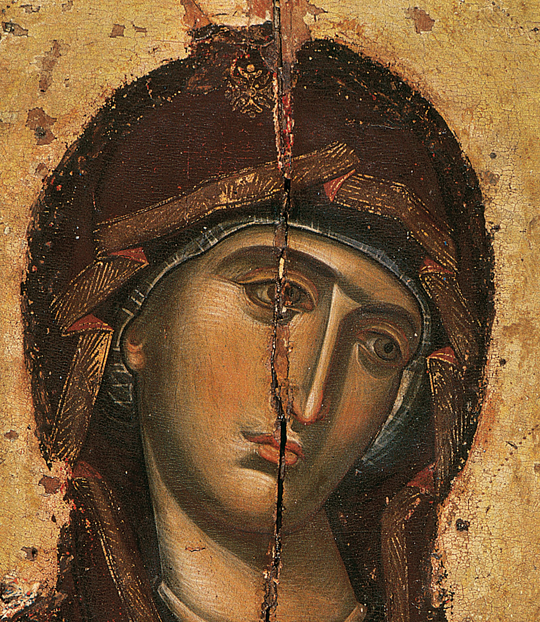
Panagia Odigitria. Portable icon of Monastery Vatopaidi. Detail. 14th c.
In the Old Testament there are many passages that foreshadow, prefigure, and prophesy Her. She is the completion, the fulfillment of the Old Testament pedagogical preparation of humanity for its acceptance of the incarnated Savior God. Our Panagia was prefigured by the burning bush in Moses’s vision, by the God-written plaques and the tabernacle of the Law, by the heavenly manna, by the golden seal, by the lamp and the altar, the blossoming rod of Aaron, by Jacob’s ladder, the wool of Gideon, Daniel’s uncut mountain, the fiery furnace which with its fire cooled the Three Children, as well as by the Holy of Holies in the tent of witness. The Theotokos is the borderline between the Old and the New Testament. For the Old Testament, she was the message of the prophets, the hope of the righteous; while in the New Testament she becomes the sweetness of the angels, the glory of the apostles, the courage of the martyrs, the delight of the venerable, the boast of humanity, which is why she is glorified by “every generation.”
All of creation awaited her birth. Our Panagia is the “fruit of creation” according to St. Nicholas Kavasilas, she is the measure that all of creation is to attain. Just as the tree exists for its fruit, in the same way creation exists for the Virgin and the Virgin for Christ. The Fathers emphasize that not only people, but also the heavens and the earth, all of visible and invisible creation were created for the spotless Virgin. When God, at the beginning of the ages, fixed his gaze on His creation, He said that it was “very good,” He essentially saw before Him the fruit of all creation, the All-Holy Theotokos, and His praise was truly the “good report of the Virgin.”
On this day, all creation receives a blessing from the birth of our spotless Lady. “This new creation,” was not simply the greatest woman on earth, nor the greatest woman of all periods, but it was she who alone could draw heaven to earth, to make God into man. The creator God the Word created human nature in such a way that when He needed to be born, He would be born from His mother. The invisible and unseen God comes to earth through her and becomes visible; He is united and communes with creation in a more substantial and united manner. Through His human nature, He unites all of creation in His hypostasis and divinizes creation. The unique and unrepresentable God takes on the “form of a servant” (Philippians 2:7), human flesh and a rational soul, lives among men and walks upon the earth. The “One who is unable to be held” will fit into the virginal womb of the Theotokos, such that His All-Holy Mother will be regarded as the “land that held Him who could not be held.”
Today Anna’s barrenness is overcome and the “keepsake of all the world,” as St. Cyril of Alexandria described her, is born. Many times in the Old Testament, God made a similar miracle: with Sarah the wife of the patriarch Abraham, with Rebecca the wife of Isaac, with Anna the mother of the prophet Samuel, with Elizabeth the mother of the prophet and forerunner John the Baptist. But today’s miracle is very different from these miracles. The children of the aforementioned mothers, whose barrenness was miraculously cured, might have been virtuous and holy, but only Mary the child of Anna and Joachim was “the one who was full of grace,” and was made, unbelievably for both men and angels, the Mother of God.
Our Panagia was not born through a virginal, supernatural conception, as the Roman Catholics mistakenly believe, but after natural relations between Joachim and Anna. Anna’s natural barrenness was overcome thanks to God’s immediate intervention as an answer to the prayers of the righteous grandparent’s of God. The elderly Joachim and Anna came together without any fleshly attraction or pleasure, but only out of obedience to God. In this way, with this action they put a stamp on their chastity. In this way, the Virgin was conceived, “chastely in the bowels of Joachim and Anna.” That she was conceived chastely means that the way she was conceived was pure. However, in order for the Virgin to be free of the ancestral sin, to have had an immaculate conception, she would have had to have been born of a virgin, as Christ was.
In order to bear such a child, the righteous grandparents of God revealed an unshakeable faith, unswerving patience, they fed the hope that does not put to shame, they had great endurance in the prayer that God would fulfill their request. And they did not endure their barrenness for a short period. The tradition says that Anna conceived the Theotokos after fifty years of barrenness.
This stance of the grandparents of God should be an example for all of us, my dear brothers and fathers. It’s not only our lay brothers, who are unable to conceive children, who should not lose their trust in God for, “the things which are impossible with men are possible with God” (Luke 18:27), but for us monks also and all the faithful who fight the “good fight.”
We often give up, or grow impatient in our struggle and say that we haven’t realized anything, we don’t sense grace, we get anxious. So, saddened as we are, our zeal is quenched, we slacken our fighting spirit and our asceticism.
We mustn’t be this way, though, my brothers. What would have happened if, because God didn’t respond immediately to their prayers, the grandparents of God had stopped calling on Him and believing that they would receive? What if they had stopped calling out, beseeching God, hoping? What great patience and strength they showed for so many years!
So as to develop the spiritual “need for great patience,” St. Isaac the Syrian lived the lessening, the absence of divine grace, the pains of noetic warfare, for thirty years. He received a constant stream of divine grace after these long years of bloody battle and patience. We refer to this, especially for us monks, who were called to receive the fullness of grace. Patience in sorrows is necessary, faith in the promises of God, perfect obedience to the will of God and hope, for we “always ought to pray and not lose heart” (Luke 18:1). God knows when it is in our interests to give us His inexplicable, unexplainable, and priceless divine gift, His divine grace as a constant state. “Spiritual gifts come upon us,” Abba Isaiah notes, we don’t decide when and how we receive them.
In fact, before God gives us some blessing, a gift, He often tests us with a temptation, the result of which determines whether or not we’re found worthy to receive this divine gift. We note this, also, in the grandparents of God who, when the time approached for God to give them a child, He allowed them to be tested even further. It was the Feast of Tabernacles, and when they went to the temple to offer gifts the priest Rubin shamed them by telling them that they weren’t worthy to offer gifts to God, as they hadn’t had any children for Israel. The grandparents of God were very saddened after this, but they did not despair. They took refuge in “deep prayer,” Joachim went to the mountain and Anna went to the garden, and their prayer was finally heard, when the angel of the Lord informed each one individually that the conception would take place, along with the birth of a child that would be known throughout the world.
And so we, too, my dear brethren and fathers, let us show ungrudging patience in our sorrows and in temptations, which God allows for our own good and spiritual growth. I pray that our Lady Theotokos and the grandmother of God Anna, who have the gift of healing barrenness, might heal our barren hearts, lacking spiritual good works, so that God might send His sweetest divine grace into our hearts, which beautifies, renews, destroys death, and saves man from corruption.

Friday, August 14, 2015

Excerpt of a Homily on the Dormition of the Theotokos by St John of Damascus (+749AD)


[171] THERE is no one in existence who is able to praise worthily the holy death of God's Mother, even if he should have a thousand tongues and a thousand mouths. Not if all the most eloquent tongues could be united would their praises be sufficient. She is greater than all praise. Since, however, God is pleased with the efforts of a loving zeal, and the Mother of God with what concerns the service of her Son, suffer me now to revert again to her praises. This is in obedience to your orders, most excellent pastors, so dear to God, and we call upon the Word made flesh of her to come to our assistance. He gives speech to every mouth which is opened for Him. He is her sole pleasure and adornment. We know that in celebrating her praises we pay off our debt, [172] and that in so doing we are again debtors, so that the debt is ever beginning afresh. It is fitting that we should exalt her who is above all created things, governing them as Mother of the God who is their Creator, Lord, and Master. Bear with me you who hang upon the divine words, and receive my good will. Strengthen my desire, and be patient with the weakness of my words. It is as if a man were to bring a violet of royal purple out of season, or a fragrant rose with buds of different hues, or some rich fruit of autumn to a mighty potentate who is divinely appointed to rule over men. Every day he sits at a table laden with every conceivable dish in the perfumed courts of his palace. He does not look at the smallness of the offering, or at its novelty so much as he admires the good intention, and with reason. This he would reward with an abundance of gifts and favours. So we, in our winter of poverty,* bring garlands to our Queen, [172] and prepare a flower of oratory for the feast of praise. We break our mind's stony desire with iron, pressing, as it were, the unripe grapes. And may you receive with more and more favour the words which fall upon your eager and listening ears.

What shall we offer the Mother of the Word if not our words? Like rejoices in like and in what it loves. Thus, then, making a start and loosening the reins of my discourse, I may send it forth as a charger ready equipped for the race. But do Thou, O Word of God, be my helper and auxiliary, and speak wisdom to my unwisdom. By Thy word make my path clear, and direct my course according to Thy good pleasure, which is the end of all wisdom and discernment.

To-day the holy Virgin of Virgins is presented in the heavenly temple. Virginity in her was so strong as to be a consuming fire. It is forfeited in every case by child-birth. But she is ever a virgin, before the event, in the birth itself, and afterwards. To-day the sacred and living ark of the living God, who conceived her Creator Himself, takes up her abode in the temple of God, not made by hands. David, her [174] forefather,* rejoices. Angels and Archangels are in jubilation, Powers exult, Principalities and Dominations, Virtues and Thrones are in gladness: Cherubim and Seraphim magnify God. Not the least of their Praise is it to refer praise to the Mother of glory. To-day the holy dove, the pure and guileless soul, sanctified by the Holy Spirit, putting off the ark of her body, the life-giving receptacle of Our Lord, found rest to the soles of her feet, taking her flight to the spiritual world, and dwelling securely in the sinless country above. To-day the Eden of the new Adam receives the true paradise, in which sin is remitted and the tree of life growl, and our nakedness is covered. For we are no longer naked and uncovered, and unable to bear the splendour of the divine likeness. Strengthened with the abundant grace of the Spirit, we shall no longer betray our nakedness in the words: "I have Put off my garment, how shall I put it on?" The serpent, by whose deceitful promise we were likened to brute beasts, did not enter into this paradise. He, the only begotten Son of God, God himself, of the same substance as the Father, took His [175] human nature of the pure Virgin. Being constituted a man, He made mortality immortal, and was clothed as a man. Putting aside corruption, He was indued with the incorruptibility of the Godhead.

To-day the spotless Virgin, untouched by earthly affections, and all heavenly in her thoughts, was not dissolved in earth, but truly entering heaven, dwells in the heavenly tabernacles. Who would be wrong to call her heaven, unless indeed he truly said that she is greater than heaven in surpassing dignity? The Lord and Creator of heaven, the Architect of all things beneath the earth and above, of creation, visible and invisible, Who is not circumvented by place (if that which surrounds things is rightly termed place), created Himself, without human co-operation, an Infant in her. He made her a rich treasure-house of His all-pervading and alone uncircumscribed Godhead, subsisting entirely in her without passion, remaining entire in His universality and Himself uncircumscribed. To-day the life-giving treasury and abyss of charity (I know not how to trust my lips to speak of it) is hidden in immortal death. She meets it [176] without fear, who conceived death's destroyer, if indeed we may call her holy and vivifying departure by the name of death. For how could she, who brought life to all, be under the dominion of death ? But she obeys the law of her own Son, and inherits this chastisement as a daughter of the first Adam, since her Son, who is the life, did not refuse it. As the Mother of the living God, she goes through death to Him. For if God said: "Unless the first man put out his hand to take and taste of the tree of life, he shall live for ever," how shall she, who received the Life Himself, without beginning or end, or finite vicissitudes, not live for ever.

Source: http://www.balamandmonastery.org.lb/index.php/st-john-of-damascus-three-sermons-on-the-dormition-feast 

Wednesday, March 25, 2015

Excerpt from the Homily on the Annunciation, by St. John Chrysostom

Again tidings of joy, again messages of freedom, again calling back, again return, again voice of rejoicing, again driving back of slavery. An angel speaks with a virgin, because a woman spoke to a serpent. “In the sixth month”, as it is written, “The Angel Gabriel was sent by God to a virgin betrothed to a man.” Gabriel was sent with the message of universal salvation. Gabriel was sent, bringing the writ of the recall of Adam. Gabriel was sent to the Virgin, that the dishonor of womanhood might be transformed into honor. Gabriel was sent, as is worthy, to rejoice at the pure chamber of the Bridegroom. Gabriel was sent, and the Creator is betrothed to His creation. Gabriel was sent to the spiritual palace of the King of the Angels. Gabriel was sent to a virgin, who though betrothed to Joseph, will bear the Son. The bodiless servant was sent to the spotless Virgin. Sin was sent free towards corruption by the inviolate one. The lamp was sent to tell of the Sun of Righteousness. The morning star precedes the light of day. Gabriel was sent to relate of Him Who is in the bosom of the Father, and in the arms of His Mother. Gabriel was sent to show Him Who is on the throne and in the cave. The solider was sent to cry out the mystery of the King. We know this is a mystery through faith, not one that can be studied in various ways. We venerate the mystery, not a joining together. We theologize a mystery, not a study. We confess a mystery, we do no count it. “In the sixth month, Gabriel was went to a virgin...”

 
And he [the Archangel] received all the commandments like these [from the Lord]: “Come, O Angel, become a servant of this awesome mystery. Serve this hidden wonder, as an answer to fallen Adam, who will come under my compassion. Sin has made he that is fashioned in my image to grow old, and has soiled my creation, and has darkened where I created beauty. The wolf has scattered my flock. The dwelling place of Paradise has become a desert. The Tree of Life is guarded by the flaming sword, and the place of nourishment is closed. I have mercy on him who was attacked, and I wish to make war with him who fought against him [i.e. the devil]. I wish for all of the heavenly powers to know, but to you alone I impart the mystery. Go to the Virgin Mary, go to the Spiritual Gate, of which the Prophet said: “Glorious things have been said of you, O City of God.” Go to my Rational Paradise. Go to the Eastern City. Go to her who is the worthy dwelling-place of the Word. Go to the second Heaven on earth. Go to the Light Cloud. Tell her of my coming, the Thunderstorm. Go to her who is my prepared holy place. Go to the Bridal Chamber of my incarnation. Go to the pure Bridal Chamber of my nativity in the flesh. Speak to the ears of this rational Ark, to prepare the entrance of my hearing. But do not be fearsome, do not trouble the soul of the Virgin...First cry out to her with a voice of joy, and tell Mariam: “Hail, O Full-of-grace,” that I might have mercy on Eve, who is full-of-shame.”

 
The Angel [Gabriel], having heard what was spoken to him, said: “Strange is this thing, surpassing every thought to speak. He Who is awesome to the Cherubim, and invisible to the Seraphim, He Who is incomprehensible to all the Angelic Powers, is proclaimed to become nature!”

 
...But having truly all of this, the Physician has come to the sick, and the Sun of Righteousness has dawned for those who sat in darkness, the Anchor and Calm Harbor to those storm-tossed, the Intercessor has been born for the despised slaves, and peace has been united, and the Redeemer of captives has come, the strong unspeakable Joy and Love and Protection has come for those who are embattled. He is our peace, as the divine Apostle says, through Whom we have all received grace, Christ our God, to Whom belong glory to the ages of ages. Amen.
 

Thursday, January 28, 2010

A guide to the Heart - The Most-Holy Theotokos and Ever-Virgin Mary


"If one examines all the feasts of the Orthodox Church carefully one realises that the Church wants to connect our life with Christ. The ecclesial year begins on the 1st of September and finishes at the end of August. At the beginning of September we celebrate the Birth of the Theotokos. It is with the birth of the Most Holy Mother of Christ that the backwards countdown for man's salvation starts. The ecclesial year continues with the Nativity of Christ up to Pentecost, which is the feast of man's deification, and ends up with the glorious Dormition of the Panagia which shows the glory that a man can reach when he is united with Christ. Thus, keeping the analogy, that what happened with Panagia should also happen to us, Christ should be born in our heart".

The Feasts of the Lord p.11, by Metropolitan Hierotheos Vlachos, Trans. by Esther Williams, Birth of the Theotokos Monastery 2003.

From http://findingthewaytotheheart.blogspot.com/